Alex Sumsky
Basketball Forever Founder, Fantasy expert



Preseason Playbook: seven edges, the numbers behind them, and my starting 15, Alex Sumsky writes
NBA
Basketball Forever Founder, Fantasy expert
October 1, 2026
Last season I finished 18th out of roughly 38,000 coaches. I’d love to tell you it was genius.
It was mostly one decision made in October: I built the highest-scoring team I could for the opening month and let the early points carry me while everyone else waited on their cheapies to mature.
This year I want better than 18th. So ahead of the Week 1 lockout at 6am AEDT on Wednesday 21 October, I went through the whole player list, every team’s schedule for all 23 weeks, and every offseason move.
Some of what came out of it surprised me. One thing in particular is sitting in plain sight in the prices, and I’m noticing many coaches don’t seem to be aware of it.
The scoring hasn’t changed. You get a point for every point, rebound, and assist, and two for every steal and block. You lose a point for every turnover and every missed shot, free throws included.
| Stat | SC points |
|---|---|
| Point, rebound, assist | +1 |
| Steal, block | +2 |
| Missed shot (incl. FT), turnover | −1 |
That missed-shot tax is the most underrated line in the game. A guard who goes 10 from 25 and 2 from 5 at the line gives back 18 points before you count a single turnover.
Efficient bigs who rebound and block shots are worth more here than their real-life reputation. High-volume, low-percentage scorers are worth less.
The bigger thing is that your team scores weekly totals. Each player banks every game his team plays from Monday to Sunday, US time. A 25-point player with four games (100) beats a 30-point player with three (90). Game counts aren’t a tiebreaker in this format. They’re a multiplier.
Three more rules shape how I play. Only your best nine of ten starters count, so a two-game player is often just your drop score. Your vice-captain only doubles if your captain plays zero games that week, not if he just has a stinker. And there is no emergency cover for the Flex, so the Flex should be your most durable player, never your biggest injury gamble.
You get three trades a week that don’t roll over, plus five one-off Trade Boosts that add a fourth trade in any week you choose. Hold onto those boosts. I’ll explain why in the schedule section.
Embed from Getty ImagesEvery opening price in this game is roughly $654,000 multiplied by the player’s 2025-26 average. I checked it at the top of the list, and it holds within a fraction of a percent. Jokic averaged 43.0 and costs $28.07M. Wemby and Luka both averaged 36.1 and cost $23.60M and $23.61M. SGA averaged 34.5 and costs $22.53M.
That sounds dry, but it’s the most useful thing in this article. The game prices every player on what he did last season and ignores everything that happened over the summer. Anyone whose role grew is priced like his old self, and so is anyone whose role shrank.
It also gives you a quick conversion. Divide any price by 0.654, and you get the average the game expects. Tyler Herro at $13.93M is priced as a 21.3-point player, and that number came from 32 games in Miami as the second option. He’s now the first option in Milwaukee.
Julius Randle ($15.29M, priced at 23.4) is Brooklyn’s featured scorer now. Coby White ($10.14M, priced at 15.5) takes over the keys in Charlotte with LaMelo gone to Minnesota.
The mechanics of price movement matter too. Prices change weekly from a rolling average of each player’s last six games, measured against his season baseline. A player needs three games before his price moves at all. A player who doesn’t play doesn’t move, but one who plays and scores badly does.
That gives any underpriced player a clear window. If his role is real, he’ll start rising from about Week 2, and the longer you wait, the more he costs.
The one big exception to the $654k rule is rookies. Because rookies have no NBA history, the game hands them a flat price between $3.75M and $5.25M. Last year that was the best money in the game.
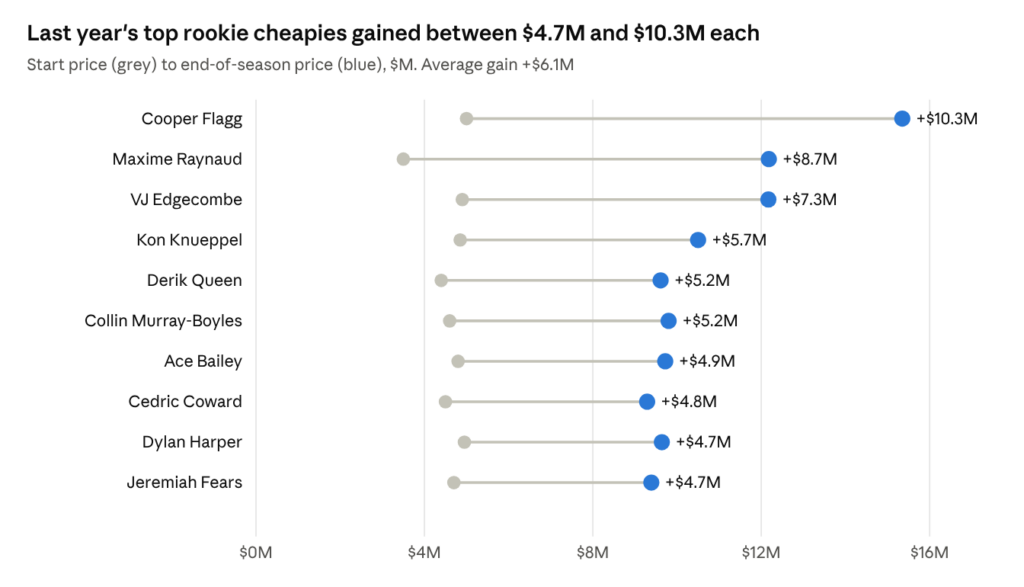
SuperCoach NBA 2025-26 start and end prices, from the in-game Past Seasons view
Flagg alone made coaches more than $10M. Raynaud started at the $3.5M floor and finished worth more than Edgecombe. None of these players were bench fodder. Flagg averaged 23.9, Edgecombe 19.6, and Knueppel 19.4, which is starting-ten output from a $5M outlay.
This year’s top three are priced as if they’ll average about 8 points a game:
| Cheapie | Team | Pos | Price | Why I’m in |
|---|---|---|---|---|
| AJ Dybantsa | WAS | SF/PF | $5.25M | No. 1 pick, starter’s minutes on a rebuilding team from night one |
| Darryn Peterson | UTA | SG | $5.20M | No. 2 pick, shares the backcourt with Keyonte George |
| Cameron Boozer | MEM | PF | $5.15M | No. 3 pick, Memphis reshaped after the Morant trade |
| Mikel Brown Jr. | BKN | PG/SG | $5.00M | No. 6 pick, rookie point guard run |
| Darius Acuff Jr. | SAC | PG | $4.95M | No. 7 pick, Kings want to see what they have |
| Keaton Wagler | LAC | SG | $5.05M | No. 5 pick, Ingram’s injury opens minutes |
The point I want to make is that the top three aren’t bench cash cows. If they score 20-plus as Flagg did, they belong in your starting ten from Week 1. You bank the points and the price rise together, and that combination is how you afford four or five guns without starting a donut on the court.
The $654k rule cuts both ways for injured players. A star who missed most of last season is priced off whatever he managed, or off an older discounted base if he didn’t play at all. This is the most crowded shelf in the game this year. Here’s how I’d sort it.
Embed from Getty ImagesTyrese Haliburton (IND, PG/SG) – $13.61M, priced at 20.8. He missed all of 2025-26 with the Achilles he tore in Game 7 of the Finals. On 2024-25 numbers (18.6 points, 9.2 assists), he was scoring in the mid-20s in SC terms. He says he’s back in shape. This is the best price-to-ceiling ratio among the guns.
Jayson Tatum (BOS, SF/PF) – $17.19M, priced at 26.3. That price comes from only 16 comeback games. Jaylen Brown is now in Philadelphia, so the usage is all his. A full healthy season from Tatum should beat 26.3 comfortably.
Domantas Sabonis (SAC, PF/C) – $16.03M, priced at 24.5. He played 19 games before a torn meniscus. Healthy Sabonis in 2024-25 averaged 19.1 points, 13.9 rebounds, and 6.0 assists, which is roughly 30-plus in SC. I think the discount is a big one.
Walker Kessler (LAL, C/PF) – $16.47M, priced at 25.2. He played five games before a torn labrum. Now he’s the Lakers’ starting centre on a four-year deal, with rebounds and blocks the scoring rewards.
Embed from Getty ImagesTrae Young (WAS) at $12.98M, Anthony Davis (WAS) at $18.23M and Kyrie Irving (DAL) at $13.23M. All three have 20-point ceilings at bargain prices. They also played 15, 19, and zero games last season, respectively. I’d start the season watching rather than owning.
Damian Lillard (POR) at $13.90M and Ja Morant (POR) at $13.14M. Lillard is 36 and back from an Achilles, and they share one backcourt. Portland’s week-1 schedule has two games too.
Jimmy Butler (GSW, $16.68M) tore his ACL on 19 January and has no firm return date. Brandon Ingram (LAC, $14.02M) needed heel surgery for a partial Achilles tear and has no timetable. Don’t start with either.
Embed from Getty ImagesThis is where the $654k rule pays out. Every player below is priced on last season’s role, not his new one.
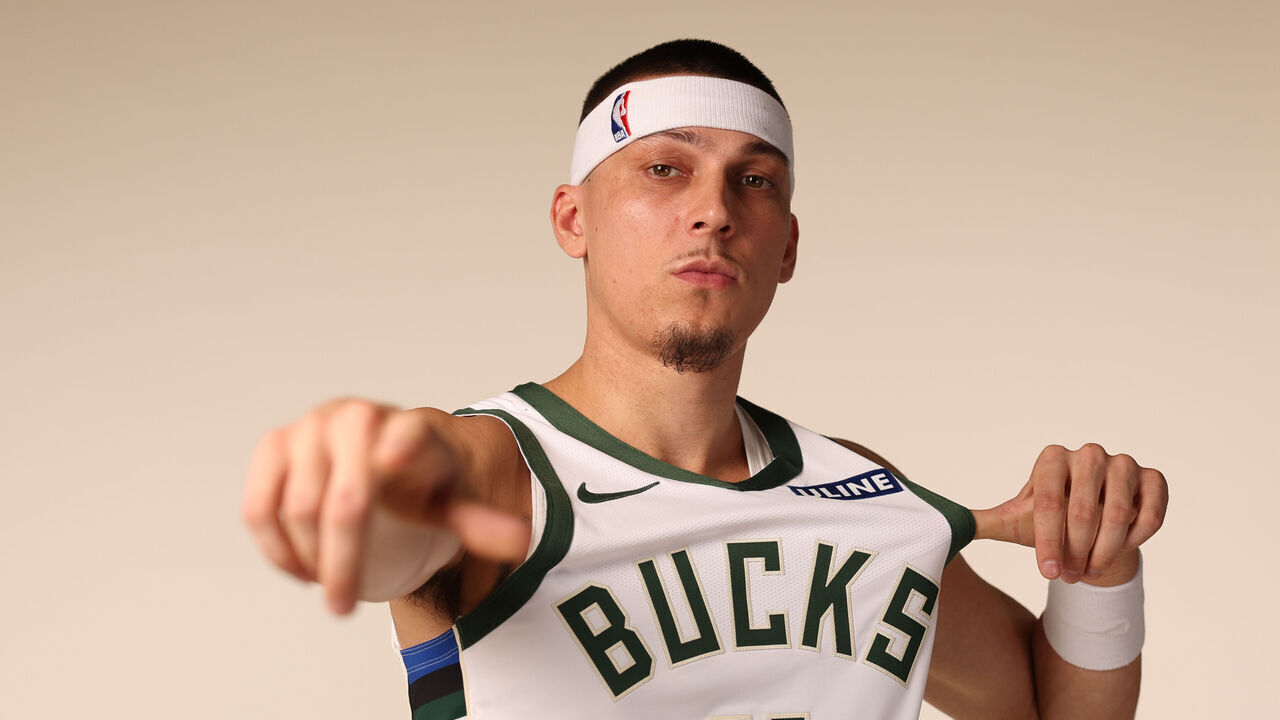
Tyler Herro (MIL, PG/SG) – $13.93M. He arrived in the Giannis trade and goes from second option in Miami to first option in Milwaukee. He’s priced at 21.3, and I think 25 is realistic.
Julius Randle (BKN, PF) – $15.29M. He was ever-present last year (77 games) and is now the man in Brooklyn. Durability plus usage is exactly what a midrange spot needs.
Austin Reaves (LAL, SG/SF) – $16.36M. LeBron has gone to Philly, so there are more touches for a player who averaged 25.0 in only 50 games.
Coby White (CHA, PG/SG) – $10.14M. He re-signed for three years and has Charlotte’s point guard job with LaMelo in Minnesota. He’s priced at 15.5.
Naz Reid (CHA, C) – $11.44M. He moves from Minnesota’s bench to Charlotte’s starting centre job.
Embed from Getty ImagesThe Philadelphia four. Maxey ($19.38M), Jaylen Brown ($17.58M), LeBron ($16.92M) and Embiid ($18.57M) now share one basketball. Someone’s numbers have to drop, and I don’t know whose yet. The one exception is Week 1, which I’ll get to.
Deni Avdija (POR, SF/SG) – $17.22M. He was one of last season’s breakout stories at 26.4, but Morant and Lillard now share his backcourt. That’s a lot of money for a player whose role just shrank.
Utah’s centres. Kessler is gone, and Nurkic ($13.92M), Mo Bamba and Jaxson Hayes are left to split the job. Let someone else guess who wins it.
I mapped every game of the 2026-27 schedule to the 23 SuperCoach weeks. In a weekly-totals format, this chart is the one I’d pin to the fridge.
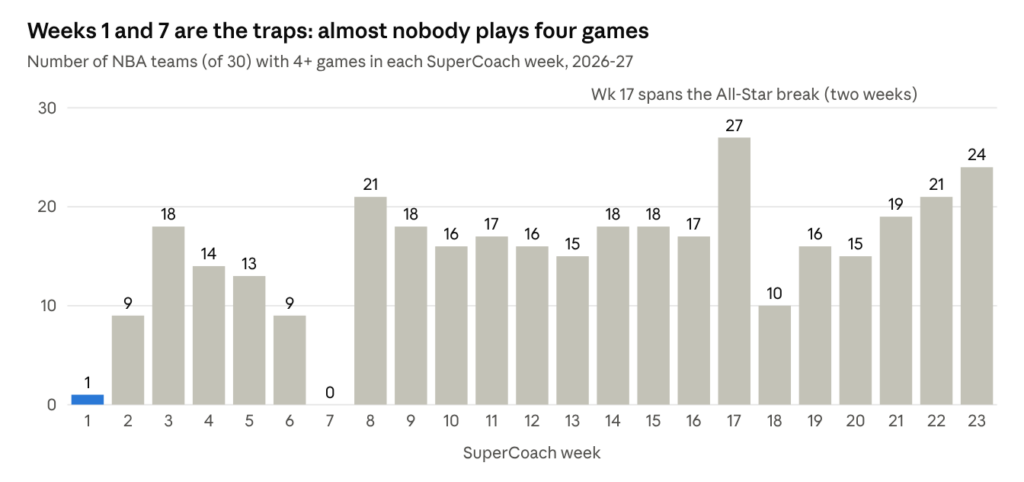
Counted from the 2026-27 NBA schedule (Basketball-Reference), mapped to SuperCoach Mon–Sun US weeks. Week 7 excludes NBA Cup knockout dates
Week 1 is a Philadelphia week. The 76ers are the only team with four games. Denver, Boston, Cleveland, Phoenix and Portland play just twice. So the Philly logjam I told you to avoid is worth a one-week look, and Maxey is a genuine Week 1 captain option.
Jokic, meanwhile, is a two-gamer. Denver also has the fewest games of any team across Weeks 1 to 4, with 11. Thirteen teams have 14: Atlanta, Cleveland, Dallas, Houston, Indiana, the Lakers, Milwaukee, New Orleans, OKC, Philly, San Antonio, Utah and Washington.
Embed from Getty ImagesWeek 7 is where the Trade Boosts earn their keep. It runs across two weeks, but games in the NBA Cup knockout window (5-12 December AEDT) don’t count, so every team plays two or three games. Dallas, Golden State, the Lakers and Orlando play twice. Anyone who’s carrying an injury into that week needs sorting.
From my reading of the key dates, the All-Star break creates a second two-week window. That makes Week 17 the fattest week of the season, with 27 teams playing four or more. Check the in-game fixture before planning around it, because I’ve inferred those week boundaries. And for the head-to-head crowd, Dallas has the most games from Week 20 to Week 23, with 16.
Same philosophy as last year. The most points I can get in the first month, a bench that grows in value, and nothing left over. It comes in at $164.92M of the $164.961M cap, so I’m $41k under.
| Slot | Player | Team | Price | Games Wk 1–4 |
|---|---|---|---|---|
| PG | Shai Gilgeous-Alexander (C) | OKC | $22.53M | 14 |
| PG | Tyrese Haliburton | IND | $13.61M | 14 |
| SG | Amen Thompson | HOU | $16.93M | 14 |
| SG | Darryn Peterson | UTA | $5.20M | 14 |
| C | Jalen Johnson | ATL | $20.18M | 14 |
| SF | Kevin Durant | HOU | $17.91M | 14 |
| SF | AJ Dybantsa | WAS | $5.25M | 14 |
| PF | Jayson Tatum | BOS | $17.19M | 13 |
| PF | Cameron Boozer | MEM | $5.15M | 13 |
| Flex | Alperen Sengun | HOU | $17.91M | 14 |
| Bench PG | Darius Acuff Jr. | SAC | $4.95M | 13 |
| Bench SG | Mikel Brown Jr. | BKN | $5.00M | 12 |
| Bench C | Mo Bamba | UTA | $4.56M | 14 |
| Bench SF | Yaxel Lendeborg | GSW | $4.75M | 13 |
| Bench PF | Koa Peat | PHX | $3.80M | 12 |
A few notes on the thinking.
Jalen Johnson’s PF/C eligibility is the key to the whole structure. He fills the lone centre spot, which frees the Flex for Sengun, and Sengun played 70 games last season. That’s exactly who you want in a slot with no emergency cover.
The Houston triple-up is deliberate. Durant, Sengun, and Amen all play four games in Weeks 2 and 4, and 14 across the first month.
The bench exists to grow. Those five cost $23.1M between them. If Acuff and Brown get the minutes their draft slots suggest, they’re next year’s Knueppel and Queen.
My captains for the first month are SGA in Week 1 (three games, Johnson VC), Johnson in Week 2 (four games), then SGA again in Weeks 3 and 4, when OKC has four games each week.
The risk sits with Haliburton and Tatum, both back from Achilles tears. If either one has a minutes limit through preseason, I’ll swap to Maxey or Cade Cunningham before lockout. I’ll call it on the pod.
Embed from Getty Images0.654. Divide any price by it to see the average the game has priced in. Then ask whether his role is bigger or smaller than last year.
1. That’s the number of teams with four games in Week 1. It’s Philly.
$10.3M. That’s what Cooper Flagg made his owners last season from a $5M start. Dybantsa, Peterson, and Boozer start at the same kind of price this year.
18. That’s the number of missed-shot points a 10-from-25, 2-from-5 night costs you before turnovers. Efficiency matters here.
5. That’s how many Trade Boosts you get. Save at least one for Week 7 and one for the head-to-head finals.
That’s the preseason playbook. Lockout is 6am AEDT on Wednesday 21 October, and you can have a laugh at my picks from Week 2 onwards. Good luck, and may your cheapies get minutes.
Leave a Reply
You must be logged in to post a comment.