Alex Sumsky
18th overall, Basketball Forever Founder



NBA Supercoach expert Alex Sumsky deep dives into the best time to sell your rookies in NBA Supercoach
NBA
18th overall, Basketball Forever Founder
November 27, 2026
Five rookies sit between 58% and 69% of SuperCoach teams. Lendeborg, Boozer, Acuff, Peterson, and Dybantsa started the season at $5.2M to $5.8M and are now worth $7.8M to $10.6M. Every one of them has made more money in five weeks than most of last year’s rookies made all season. Which is why every group chat has the same question in it: when do we sell?
The usual answer is “when they hit the rookie wall”, said with the confidence of someone who has never checked whether the rookie wall exists. So I checked. I pulled every week of last season’s price and scoring data for the 2025 rookie class, the eleven who mattered, and looked at what actually happened to their prices and their minutes from October to April.

There is a wall. It isn’t about tired legs, and it doesn’t hit everyone. It hits one specific type of rookie; it hits them between Week 11 and Week 13, and this year’s five are all that type.
Last season’s eleven relevant rookies didn’t share one price curve. They split cleanly into three.
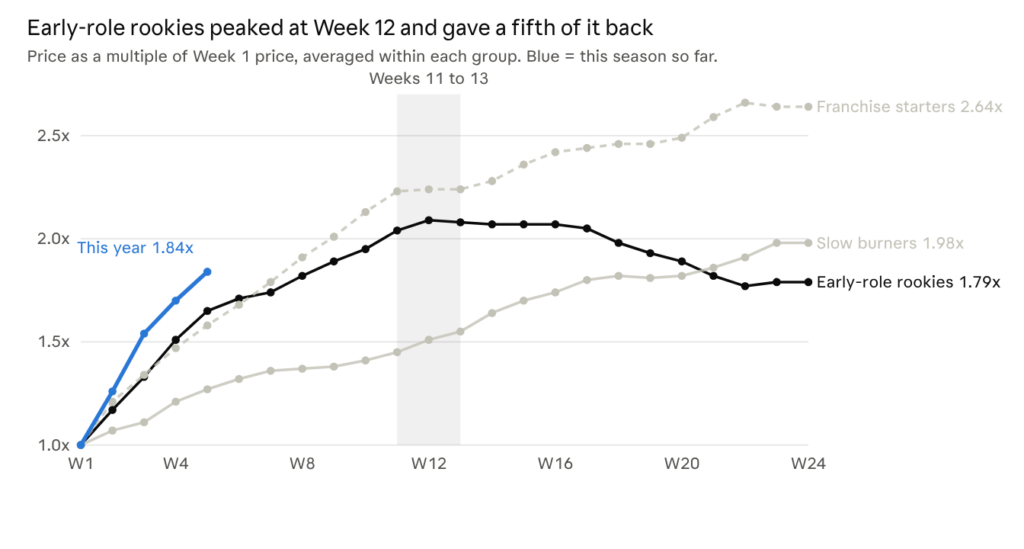
SuperCoach NBA weekly prices, 2025-26 rounds 1 to 24 for eleven rookies and 2026-27 rounds 1 to 5 for Lendeborg, Boozer and Acuff
The early-role rookies. Kalkbrenner, Derik Queen, Knueppel, Coward and Tre Johnson. Players who had a real rotation spot from opening night, scored from Week 1 and were in the template by Week 4. Their prices doubled by Week 12, then went backwards. Kalkbrenner peaked at $9.3M in Week 11 and finished at $7.9M.
Queen peaked at $11.9M in Week 12 and finished at $9.6M. Knueppel held on until Week 17 and then lost $2.1M. Coward peaked in Week 13. Johnson gave back everything he’d made. Averaged out, this group peaked at 2.09 times their starting price and finished at 1.79.
The franchise starters. Flagg and Edgecombe. Thirty-plus minutes a night from day one on teams that were never going to take them off the floor. They rose with the early-role group until about Week 10, kept going when the others stalled, and were still climbing in March. No wall at all.
The slow burners. Harper, Bailey, Murray-Boyles, Fears. Rookies whose minutes arrived in January rather than October, usually because a veteran got hurt or traded. They were ordinary SuperCoach assets until Week 12 and the best rookie holds in the game from Week 14 on. Harper’s price in Week 12 was below his Week 2 price. He finished at $9.6M.
Notice the blue line. Lendeborg, Boozer, and Acuff are at 1.84 times their starting price after five weeks. That’s ahead of last year’s early-role group at the same point (1.65) and ahead of Flagg and Edgecombe (1.58). This class isn’t following the rookie curve. It’s running a faster version of it.
The rookie wall story is about fatigue. College kids playing 82 games for the first time, December hits, the legs go. If that were true you’d see scoring per minute fall while minutes held. That isn’t what happened to the early-role group. Their minutes fell.
| Early-role rookie | Weeks 1 to 4 | Weeks 9 to 12 | Weeks 17 to 20 | What changed |
|---|---|---|---|---|
| Kalkbrenner (CHA) | 21.0 pts in 27 min | 14.6 in 20 | 12.1 in 17 | Rotation tightened once the Hornets’ bigs were healthy |
| Derik Queen (NOP) | 15.5 in 22 | 21.3 in 27 | 12.6 in 19 | Minutes cut by a third in the new year |
| Coward (MEM) | 19.1 in 27 | 20.1 in 25 | 15.7 in 24 | Minutes held, scoring fell. The one genuine efficiency wall |
| Knueppel (CHA) | 17.9 in 32 | 20.1 in 29 | 19.8 in 29 | Held until the last month, then 14.5 in 31 |
| Tre Johnson (WAS) | 10.1 in 25 | 13.4 in 26 | 7.2 in 22 | Faded with the minutes |
Kalkbrenner lost ten minutes a night between October and February. Queen lost nine. That isn’t a rookie hitting a wall; it’s a coach deciding the rookie was a stopgap. The one case that looks like actual fatigue is Coward, whose minutes stayed around 25 while his scoring dropped by a fifth, and even he recovered to 17.8 a game by the run home.
The franchise starters are the control group. Flagg’s minutes were 34 in October and 33 in April. Edgecombe’s were 37 and 35. Neither hit anything. The slow burners went the other way, because their minutes arrived late: Harper from 20 a night in November to 24 from January, Murray-Boyles from 16 to 29.
So the question to ask about a rookie isn’t “is he tired”. It’s “who takes his minutes when the team gets healthy, and when does that happen?”
Here’s the part that matters even if the minutes never fall. SuperCoach prices move on a rolling six-game average, which means a rookie’s price keeps climbing only while his recent scoring stays above what his price already assumes. The gap closes on its own. A rookie who scores 20 a game every week from October to April still stops making money the week his price reaches the level that implies 20 a game.
Last season, the early-role group had banked 94% (Kalkbrenner) and 89% (Queen) of their entire season’s price gain by Week 9. The class as a whole, all eleven, had banked 57% by Week 9, 77% by Week 12 and 85% by Week 16, and that includes Flagg, who kept rising until Week 22.
Put another way: for the template rookies, Week 12 was the point of maximum value, and the only ones who kept adding after that were players whose roles were still growing.
This year’s five aren’t growing into roles. They started in them. Boozer, Dybantsa and Acuff are starters. Lendeborg is playing 33 minutes because Butler’s knee is gone for the season. Peterson’s minutes bounce between 19 and 34 depending on the night. That’s the early-role profile, and they’re running it faster than last year’s version did, which argues for the peak arriving on time or early, not late.
Two numbers decide the sell date. How far a rookie’s last six games sit above what his price already assumes, which tells you how many weeks of price growth are left. And who is coming back to take his minutes, which tells you whether the growth stops gently or falls off a cliff.
| Rookie | Price | Price assumes | Last 6 | Gap | Minutes, last 3 weeks | Who takes the minutes |
|---|---|---|---|---|---|---|
| Yaxel Lendeborg (GSW) | $10.12M | 15.5 | 15.5 | 0.0 | 32, 29, 33 | Curry (oblique), due back around the start of December |
| Darryn Peterson (UTA) | $9.23M | 14.1 | 15.8 | +1.7 | 32, 33, 27 | Markkanen (fracture), due back mid-December |
| Darius Acuff Jr (SAC) | $9.71M | 14.8 | 18.5 | +3.7 | 38, 36, 37 | Nobody. He’s the starting point guard |
| Cameron Boozer (MEM) | $10.61M | 16.2 | 26.7 | +10.5 | 34, 30, 28 | Nobody, but his ankle has him out for now |
| AJ Dybantsa (WAS) | $7.83M | 12.0 | 20.2 | +8.2 | 33, 36, 35 | Nobody. Thirty-five minutes on a team going nowhere |
Lendeborg is done, and he’s done now. His price assumes 15.5 a game, and his last six average 15.5. The gap is zero, which means his price moves sideways from here on current form, and his last four games are 27, 13, 21, 11. Curry is due back around the start of December, and the Warriors play two games in the Cup week. He is 69% owned, which means selling him is the single most common move nobody has made yet. Make it this lockout or next.
Peterson has a fortnight. A 1.7-point gap at 15.8 a game is a week or two of small rises, and Markkanen’s return in mid-December is the ceiling on his minutes. He’s the Kalkbrenner of this class: real player, temporary role. Sell him into the last rise, which is Week 7 or 8, not after it.
Acuff is the swing case. Starting point guard, 37 minutes a night, nobody obvious to take them. The gap says two or three more weeks of growth. If his minutes hold through December, he drifts toward the franchise-starter curve and becomes a hold. If Sacramento tightens the rotation, he’s Queen, and Queen gave back $2.3M. Watch the minutes, not the score.
Boozer and Dybantsa are the two you keep. Both have eight to ten points of gap left, which at the current pace is a month of rising prices, and both are starters nobody is going to bench. Dybantsa in particular looks like Flagg’s curve with a lower ceiling: a bad team with no reason to take him off the floor.
Boozer’s ankle freezes his price while he’s out, since the rolling average doesn’t move without games, so the runway is paused rather than shortened. Neither is a sell before Week 10 on anything we can see today. (Since this was written, Boozer has been ruled out for a month, so now he is most likely a sell and buy back).
The pattern to take away is the one last season taught. The template rookies peak together, around Week 12, and the field sells them together, late. The money is in selling the first one or two three weeks before everybody else does and leaving the real starters alone.
Leave a Reply
You must be logged in to post a comment.