Matty G
NBA Fantasy Basketball analyst



From red-hot rookies to a crazy start to the MVP race, NBA Supercoach expert Matt Garrett shares his biggest early season takeaways
NBA
NBA Fantasy Basketball analyst
November 9, 2026
Three weeks into the SuperCoach season, and we have already experienced the full emotional range. The rookies are making money, the premiums are testing our patience, and somebody on your roster has probably developed a mysterious back complaint since you last checked your phone.
There is enough basketball now to start learning something useful, even if there is still plenty of room for the next week to make us look foolish. These are my ten takeaways so far, and what I am doing with them as we plan the next stretch of trades.
We knew this class was good coming in. We had watched the tape, read the reports, and spent the preseason convincing ourselves that approximately 14 different rookies were essential selections. Somehow, the kids have still managed to exceed expectations. They are generating the kind of cash that had Tom Cruise yelling “SHOW ME THE MONEY!” down the phone in Jerry Maguire.
And the opportunities extend beyond the headline acts. Mara, Burries, Flemings and Wagler remain among the cheaper names worth examining, particularly where low breakevens meet a genuine rotation role. They give us a way to bank the profit from an earlier selection, release funds for an upgrade and keep the cash generation moving.
The important part is that last bit. A downgrade should still have somewhere to go. Cheap is lovely, but cheap with ten uncertain minutes and a coach who changes his rotation like his jocks will leave your money doing absolutely nothing.
Look at the minutes, the opportunity, and the upcoming games alongside the breakeven. Are they playing because somebody else is injured? Will that role survive a returning starter? Can you actually field them if required? We want the next cash cow, not a decorative garden ornament wearing an NBA jersey.
Let’s make this quick. Injuries are ever-present in fantasy and SuperCoach. Inescapable. And they hurt.
The injury report is developing more subplots than a prestige television drama, and we have barely settled into the couch.
The damage goes beyond the missing score. An injury can force a sale before a cash cow has finished appreciating (see: Tyrese Haliburton) and derail a carefully planned upgrade or swallow the trade you had reserved for next week’s schedule swing. Suddenly, your beautiful three-week plan is a napkin covered in crossed-out names.
That is why I want some flexibility in the squad. A usable bench option and room to move between positions can matter enormously when late news arrives. Assess the likely absence against the games lost, the money tied up, and the replacement available. A one-game absence and a multi-week injury deserve different responses.
We cannot prevent the injuries. We can give ourselves a better chance of surviving the next one without setting fire to the entire trade plan.
My SC Playbook friend and colleague Sumsky (his mum calls him Alex) has already made the case in his article, (Don’t Sell the Premiums). It is a useful reminder when an expensive player has a quiet week, and the trade button starts whispering sweet nothings.
Investing BIG in a BIG-TIME player ties up a sizeable chunk of the budget. When two cheaper options are firing, spreading that money around becomes tempting. Sometimes it is the right move. But an ordinary fortnight does not automatically mean an extraordinary player has forgotten how to play basketball.
Take Nikola Jokic. After a couple of underwhelming weeks, some managers understandably wanted to back a different horse. Then The Joker delivered 119 SuperCoach points across a three-game week. That is a rather persuasive response from the stable.
I would call that a reminder of his scoring capacity rather than a guaranteed weekly floor. Even the best have quiet games. What separates them is how often they can produce a total that makes the extra game you chased elsewhere feel considerably less valuable.
Breakevens still matter. A premium can score well and lose money if the target is steep enough. For prospective buyers, that can create a more attractive entry point. For existing owners, the question is whether the projected price loss outweighs the points, captaincy value and trades involved in selling and buying back. Do the maths before making the emotional support trade.
The little Jerome engine that could is gathering a fair bit of steam.
I was big on Jerome as a fantasy asset last year before an untimely preseason injury and prolonged recovery restricted him to 15 games. The flashes in Memphis were there. Getting enough opportunities to enjoy them was another matter entirely.
Now he is humming, averaging 24.6 SuperCoach points at around $601k in the figures I am working from. With Memphis approaching a four-game week and his ownership sitting at 11.4%, there is an appealing combination of production, price and opportunity.
For context, maintaining that average across four appearances would return roughly 98 points. That is a projection, of course, and availability remains part of the calculation. But it explains why he deserves more than a passing glance while you shop for the familiar names.
The appeal is strongest if the role and minutes remain secure beyond the immediate schedule bump. We do not want to buy a four-game week and discover we also bought an exit trade seven days later. Check the next stretch, weigh the health concerns, and work out which upgrade his price allows elsewhere. Jerome could be a very useful passenger for that journey. Possibly even the bloke driving the train.
If this continues, the MVP conversation is going to be wonderful. The SuperCoach captaincy conversation might require a support group.
Luka Doncic and Victor Wembanyama occupy the top two spots for total SuperCoach scoring in my Week 3 snapshot, and they are arriving there through performances that barely seem reasonable. Luka has been piling up enormous scores despite missed games. At his current 39.8-point average, eight appearances would equate to 318.4 SuperCoach points. We do not get to collect hypothetical points, sadly, but that gives you an idea of the pace.
Then Wemby casually produces 52 NBA points, 24 rebounds and eight blocks against Dallas. That is the sort of line you used to enter into a video game before your mate accused you of changing the sliders.
The distinction matters when we assess their SuperCoach output. A monster game can shift an early-season average substantially, while a missed appearance changes a weekly total just as dramatically. Look at both the per-game production and the games you can reasonably expect them to play.
Neither has to win the NBA MVP for you to win your round. We need the best scoring opportunity for the week in front of us, with captaincy making the consequences even bigger. Enjoy the show. Then check the injury report before handing out the armband.
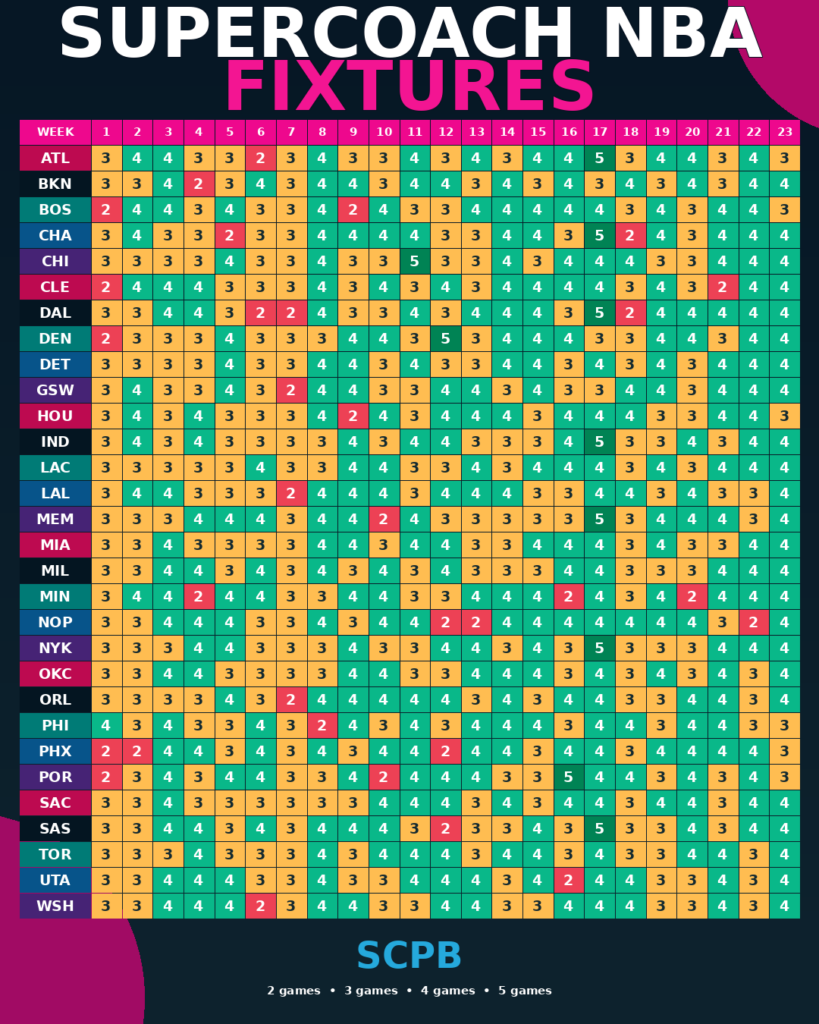
Week 8 deserves a large circle on the calendar, with 21 teams scheduled for four games. There will be plenty of ways to chase volume. There will also be a few price projections that make managers sit up rather abruptly.
Take Yaxel Lendeborg. I love Yaxel. You love Yaxel. Our projected breakevens, however, are about to test the relationship. The figures I am looking at move from minus 22 in Week 7 to 62 in Week 8, then 55 in Week 9. Golden State goes from two games in Week 7 to four in each of the next two rounds.
Those are projected targets, not numbers carved in stone. Future scores and the results cycling through the pricing calculation can change them. Nor should we assume the extra scheduled games alone explain the jump. The useful warning is that today’s easy cash generation may look very different a few rounds from now.
Compare the expected round score with the relevant breakeven, then look at the replacement and the cost of making the move. A rising target can justify a sale, but it does not demand one regardless of everything else.
Get ahead of the decision while you still have choices. Otherwise, that little yodelling bloke from The Price Is Right that keeps climbing the price guessing mountain will fall off the edge real quick.
At 9–2 in the snapshot for this piece, Philadelphia has made a fairly convincing opening argument. Turns out a team with that much talent might be reasonably good at basketball.
The more useful question is where we want our SuperCoach investment. For me, Tyrese Maxey and Jaylen Brown are the clearest starting points, with Maxey the preferred option.
There were understandable concerns that the arrivals in Philadelphia would take too much off his plate. Instead, Maxey has continued to lead the way: fifth for total SuperCoach points and 12th on average at 28.6. More mouths to feed has not stopped him from getting a very healthy serving.
Embiid’s availability remains difficult to build around, while LeBron James has been comfortable facilitating and playing the role the team needs. Both can be excellent basketball players without being the best purchase for our particular week. The anticipated missed time only complicates the equation.
Maxey narrowly missed the century in Week 3, and a breakeven of 106 means the price still warrants attention. A four-game week at his current average would project to 114.4 points, illustrating why the schedule changes the buying conversation. That is no promise of a profit or a score, but it puts the target in context. Brown belongs in the discussion too; Maxey gets my first look.
Cooper Flagg finished Week 3 third for average SuperCoach scoring in my figures, at 35.2 points per game. That is not merely impressive for a young player. That is an expensive problem for anyone who does not own him.
Naturally, the schedule has arrived to make the decision unpleasant. Dallas drops to consecutive two-game rounds in Weeks 6 and 7. Flagg can be brilliant and still struggle to match a good player who gets twice as many opportunities.
As a simple illustration, two games at his current average produce 70+ points. A player averaging 24 across four games projects to 96. There are no guarantees in either number, but the gap shows why “he is too good to sell” needs a little more interrogation in this format.
Week 7 may be easier to tolerate when the alternative is often only one extra game. Week 6, with four-game options available, is a tougher pill. Consider the full two-week return, the cost of the replacement, and whether you can realistically afford to bring Flagg back. And I think you’ll come to the same conclusion: it’s not ideal to sell him just to bring him back.
My planning windows for a return are around Week 11 or Week 13, with a potential hold through Week 16 before another two-game dip in Week 17. Health, price, and form will have their say. Put those windows in the plan now so selling him does not become an accidental season-long farewell.
I would just like that on the record.
Watching Stephen Curry in this sort of form is pure joy. The preseason conversation around Golden State had started to feel grim. There was all that talk of a gap year, of waiting for whatever comes next, as though a season of Steph doing Steph things was something we could afford to leave sitting on the shelf.
I do not know how many seasons of this we have left. None of us does. But watching the greatest shooter the game has seen still turn an ordinary possession into a small act of sporting vandalism is a privilege. Spare a thought for the defender who follows him around three screens, does almost everything right and still gets a three dropped on his forehead.
Fortunately, the SuperCoach case is rather enjoyable too. Curry is averaging 29.2 points at around $560k in my snapshot. Four appearances at that rate would equate to 116.8 points, which is a pretty compelling reason to keep Golden State’s schedule within reach.
We still need to account for availability and the possibility that a condensed stretch does not produce every scheduled appearance. But there is value here alongside the entertainment. Sometimes the numbers and the basketball fan in you agree. Steph gonna Steph.
I have been asked a couple of times why Wemby is listed as a forward. I have no idea.
Walker Kessler’s forward availability also raises an eyebrow when you watch where he spends his working day.
Then there is Jaylen Brown retaining guard eligibility while being used across the forward spots in Philadelphia, and Cooper Flagg’s listing failing to mirror how Dallas may deploy him in its starting group. Trying to make every SuperCoach label line up neatly with an NBA rotation is an excellent way to lose an afternoon.
What matters for our teams is the eligibility displayed in the game. Use that as the starting point when planning your trades.
Where dual eligibility is available, map out the positional switches before committing. Moving an existing player can open the slot you need for an incoming target, preserve a useful bench option or help you cover an absence. Sometimes the apparent positional problem is already solvable with the players you own.
That flexibility has value across the season. It can keep a straightforward upgrade from becoming a chain of corrective trades, and help preserve a boost for a week when you actually need the extra move. We cannot make sense of the labels. However, we can make sure we get everything available out of them.
Leave a Reply
You must be logged in to post a comment.